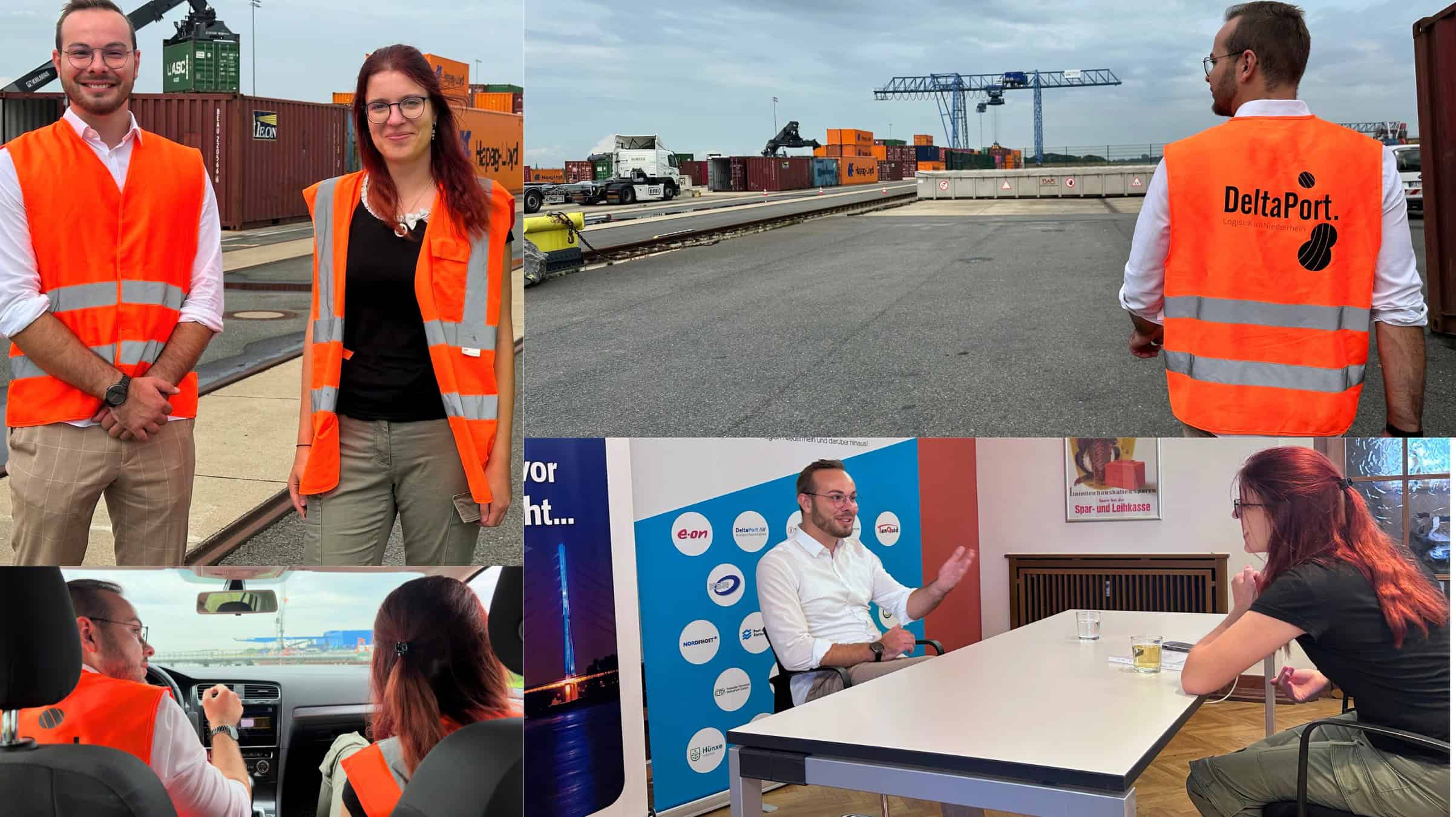
Interview with Mario Althof, Deltaport Niederrheinhäfen GmbH
Wesel, 2025-05-07 – Mario Althof joined DeltaPort Niederrheinhäfen GmbH in 2022 as part of his master’s thesis and works in controlling and project management. He also advises the management on research and transformation projects. With the EcoPort813 – Association for Hydrogen and Sustainable Energy e. V., the company is currently in intensive exchange with the innovation platform startport GmbH – a subsidiary of Duisburger Hafen AG.
Could you briefly explain DeltaPort’s mission and core activities?
“Certainly. DeltaPort is a public port operator and, in its role, a landlord that develops, markets, and manages the port areas and railway operations of the Rhein-Lippe-Hafen, Stadthafen Wesel, and Hafen Emmelsum. Furthermore, we participate in various projects focusing on digitalization, mobility, and sustainability – with projects for automation, for shifting freight flows to rail and water, and for CO2 neutrality through the expansion of our ports into a hydrogen hub.”
How are the demands of your tenants for logistics spaces and properties changing?
“The demands on logistics have fundamentally changed due to climate goals and events such as the Suez Canal blockade, the COVID-19 pandemic, and the Ukraine conflict. Future-proof logistics chains must offer flexible solutions for global challenges; they must become more resilient and, at the same time, more sustainable.
Modern infrastructures, development areas, and an innovative environment are crucial for this. Our trimodally connected locations on the Rhine and the Wesel-Datteln Canal offer a competitive advantage for building such multimodal and resilient supply chains, thanks to their congestion-free location and low-water access.
In addition, we offer tenants long-term perspectives, such as planning security through long-term contracts, cooperation and development opportunities in digitalization and automation, and access to sustainable research projects. Because in addition to technical aspects, these ‘soft skills’ are gaining particular importance.”
Which projects have you implemented recently that have been particularly successful?
“Our projects pursue a future-oriented transformation process, the success of which will become apparent in the coming years. However, I would still like to highlight two projects where we see enormous potential.”
We are particularly proud of the establishment of the EcoPort813 support association. The association promotes the cross-border development of a hydrogen infrastructure by bringing together relevant stakeholders and creating synergies. In addition to municipal support and cross-sector collaboration, we have a strong consortium with the seaports of Rotterdam and North Sea Port, as well as the inland ports of Duisburg and Dortmund, to realize the development of a hydrogen value chain.
The second project I would like to highlight is the LOG4NRW project. This is an alliance between DeltaPort and the ports of duisport, Dortmund, and Kreisbahn Siegen-Wittgenstein. The goal is to make freight transport in NRW more sustainable by shifting more traffic to rail and waterways and using trucks only for the last mile. This is achieved through a container round-trip system that dynamically expands with additional locations.
What are the next milestones for the LOG4NRW project?
“We are currently in the first of five phases.
This first phase aims to connect all locations via a train system, which will be supplemented by inland waterway transport in the second phase.
After completion of these phases, the network will be expanded to include further locations. Once the system is successfully established, it will be opened for the supply of urban areas with small-scale general cargo in the B2C sector. Here, disused colliery transshipment points are to be reactivated as micro-depots.
In the final stage of development, the logistics network will be used for the distribution of hydrogen via containerized compressed gas cylinders.
We are thus already creating the structures for an optimal distribution network in NRW that can directly connect to the hydrogen value chain.”
How does LOG4NRW contribute to the sustainability of general cargo logistics in NRW?
“In the LOG4NRW project, we utilize the free capacities on the Rhine, as well as the widely branched canal network and the dense rail infrastructure. This reduces the burden on roads, increases the operational efficiency of truck drivers, and contributes to the decarbonization of freight transport by using more sustainable modes of transport: inland waterways and rail.
Additionally, we create resilience and thus economic added value. For the first time, this network has connected the ports in the Ruhr area with the northern ports, and the Siegerland region with the western ports. This allows for flexible rerouting of goods flows even in the event of failures of individual ports and transport modes.”
What is your vision for the future of general cargo logistics in NRW?
“General cargo logistics will undergo a sustainable transformation. With the transport transition and climate goals, road freight transport in the main haul will have to be replaced by alternative modes of transport; road congestion must also be reduced.
The goal must be to use trucks only for the last mile or to replace them entirely with more sustainable alternatives. In addition, individual supply chains will be digitally networked in the future, which promotes the development of synchromodal transport chains.”
How do you view the role of startups and innovations in logistics?
“Startups play a significant role for the entire economy. A central role is digitalization and automation. In particular, the integration of AI systems into logistics networks will continue to increase. For example, for optimizing routes and inventories, but also in risk management, to detect system disruptions early and be able to react. Here I still see a significant need for development and potential for startups.”
Is there anything else you would like to share with our community?
“We are in a transformation process that poses major challenges for the entire logistics industry. We must free ourselves from egoism and isolated solutions and broaden our approach. Issues such as the energy and transport transition can only be successfully implemented if we open ourselves up to cooperation and transparency along the supply chain. We have the competencies required; let’s make something of it.”
————————————————
Brief Profile: DeltaPort Niederrheinhäfen GmbH at a Glance
The transport of almost all types of goods, such as bulk goods, general cargo, heavy goods, liquid goods, and containerized goods, can be realized via the port locations of DeltaPort Niederrheinhäfen GmbH (Orsoy – Voerde – Wesel – Emmerich).
https://deltaport-niederrheinhaefen.de
Click here for the video interview: