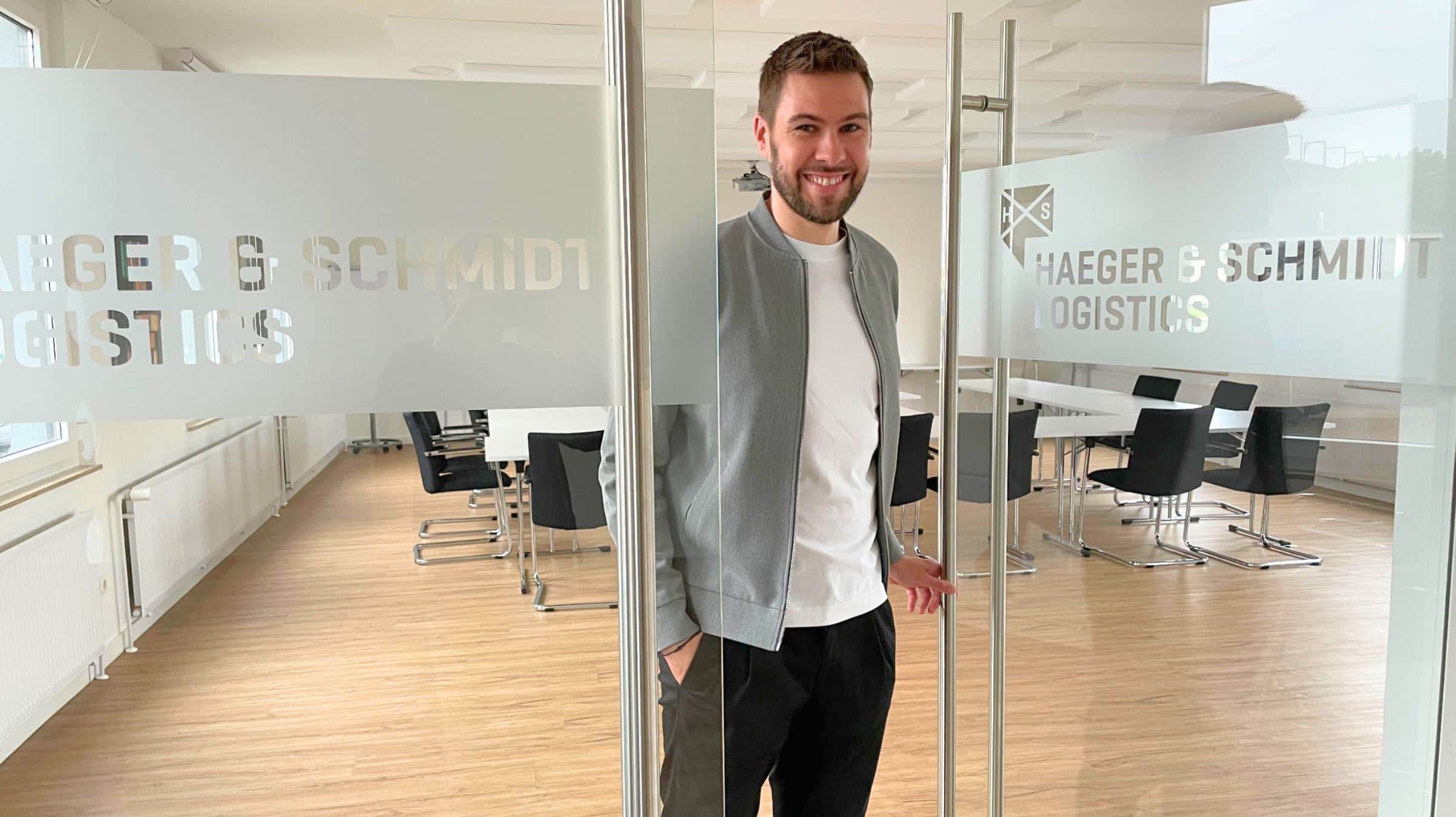
Interview with Torben Radtke, Haeger & Schmidt
Robots, data octopus and AI: Haeger & Schmidt talks about innovative projects
Duisburg, 2024-06-11 – Torben Radtke joined Haeger & Schmidt in 2018 as part of his master’s thesis and works in process and project management. There, he is primarily involved in digitalization projects and the search for innovative solutions and is therefore also in close exchange with the innovation platform startport GmbH – a subsidiary of Duisburger Hafen AG.
Can you give us an insight into your current logistics project? What are the goals behind it, and what innovative implementations are you working on there?
“We are currently working on several projects. One project I would like to highlight is an AI project and the development of a sales assistant. This means that we want to automatically read emails with customer inquiries about potential transports, extract the data, and then automatically submit a quote to the customer for our transport services. In another project, we are currently trying to set up an assisted dispatching process. In other words, given the flood of data that currently exists, our dispatchers who schedule our trains and ships should receive support so that all incoming data is consolidated. The constraints are reviewed and a dispatching recommendation for our ships and trains is then issued.”
What specific challenges were there in the latest logistics project and in its implementation?
“The challenge, of course, is always that you have to bring all employees along with you, i.e., truly involve them and make them part of this project. These people hold so much operational knowledge that we absolutely need in order to implement this project successfully. But it is also very important to receive input and support from external sources so that you can really make such a project a success. In the end, the domain expertise is there, as is knowledge about AI technologies, and these two things then have to be brought together in a project.”
And how exactly did you involve employees in the process?
“You have to talk to employees right from the start and bring them into the project team. They should be on board from the very first formulation of the requirements, so that we then really know what we actually want to develop, what the issues are, so that the specialist side can develop in the right direction and, in the end, the needs of the employees are met.”
Have you recently implemented new methods or technologies that optimize the efficiency of your logistics processes?
1. What we have done gradually over the past few years is introduce RPA processes. RPA stands for Robotic Process Automation. Here, we have a robot handle simple processes where the work steps are always the same and have to be carried out in the system. It essentially takes over the steps that an employee would otherwise do, thereby providing relief.
2. Another thing we have done is try to centralize platforms. I will use our platform for ocean vessel arrivals as an example. Our dispatchers always need to know when the ocean-going vessels will arrive at the seaports. It used to be quite laborious to check all kinds of terminal operator platforms to see when the vessels would arrive and when things would continue. That is why we created an internal central platform where our dispatchers can check when the vessels arrive, so they can improve their planning.
3. We use Lobster_data as a tool for data integration. That is our data octopus, as we like to call it. Here, we bring logistics solutions together via a wide range of API interfaces, create the link to customers, and have the ability to collect, process, and distribute data onward into our systems. By now, we have already implemented around 500 interfaces with it.
Back to the robot topic. Does it happen to have a name too—like some robot vacuum cleaners these days?
The robot processes directly at our company do not have a name. What does have a name is our frontend towards ChatGPT. It goes by the name HSL Hugo.
How do you see the role of artificial intelligence in the logistics industry in the future?
I think that artificial intelligence can be a real game changer in the logistics industry. It could indeed turn the entire logistics world upside down again, simply because the technologies are so innovative and bring such major relief. And with all the data streams that currently exist and are still being built up and increasing, it will no longer be possible for people to reconcile all this data, analyze it, and draw the right conclusions from it. That is why I do believe that AI support will become a very major topic.
Are there current trends that influence your projects at Haeger & Schmidt?
The major trend is, of course—and this is also a very important topic—sustainability. It also plays a major role in our transports. As an inland shipping company, you are generally more sustainable because we can simply carry much more than, for example, a single truck. That speaks for the rail and inland shipping products we offer. Of course, it is also important to reposition yourself as a company and really rethink things. This year, we installed a photovoltaic system on the roof and are trying to move into the future and become greener through the use of, for example, electric trucks.
—————————–
Haeger & Schmidt Logistics
Haeger & Schmidt Logistics, headquartered in Duisburg, is a leading logistics service provider with a focus on sustainable transport concepts for containers, steel products, heavy cargo and project cargo, particularly along the Rhine corridor. Around 200 employees work in the business areas of inland shipping, projects, port logistics, intermodal, freight forwarding and shortsea. Since 2013, the group has been part of the Austrian family-owned company Felbermayr. https://haegerundschmidt.com/