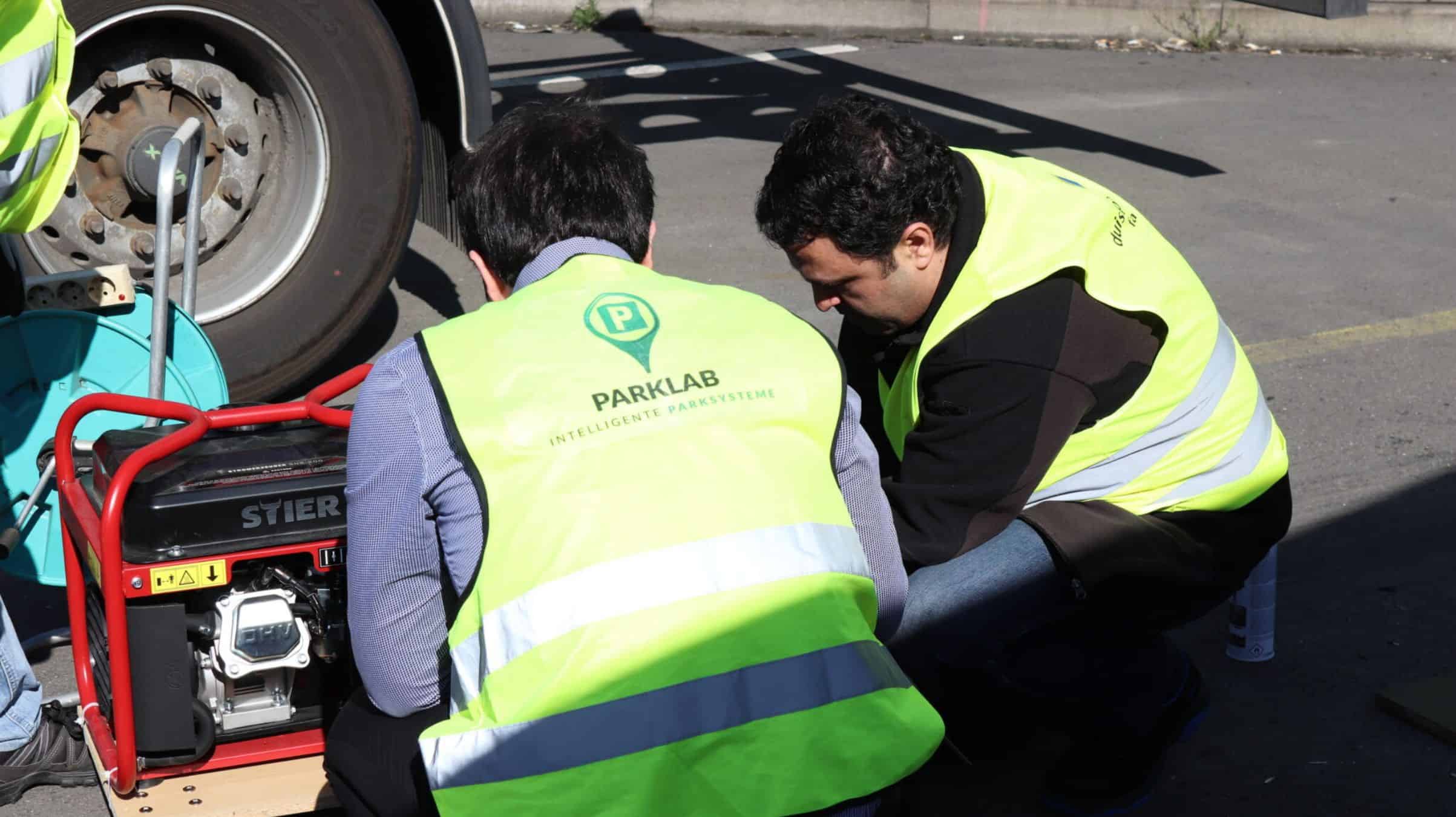
The startport startup PARKLAB Technologie GmbH from Batch 4 enables the real-time determination of parking space occupancy. This information is passed on to drivers via software, allowing them to conveniently find a parking space at their destination using an app.
In order to obtain an even better overview of the capacity utilization of parking areas at the terminals, the duisport Group is also relying on this increase in efficiency in the Port of Duisburg.
The starting signal for the collaboration was the installation of the necessary sensors on the parking areas of the duisport terminal logport III at the former Duisburg-Hohenbudberg shunting yard.
In addition to recording current parking occupancy, the startup’s solution also provides data on the daily and monthly number of vehicles, total and average parking times, and daily traffic volume. Thanks to the connected software, it is then possible to implement numerous optimization approaches.
Mr. Mirco Nolte – Press Spokesperson at PARKLAB Technologie GmbH, was available to startport for an interview.
Question 1: To what extent can workflows be made more efficient through your innovative technology?
Our sensor technology allows processes to be optimized, particularly on the parking areas of logport III, as the usable space for truck trailers can be utilized as effectively as possible. For duisport, it is now transparently visible how long a trailer remains in a respective parking space; from this, it can be deduced how long a trailer needs until it leaves the premises and what the throughput is. Existing company data is integrated with the collected PARKLAB data, meaning PARKLAB assists in optimizing supply chain management and offers an even more efficient solution for the logistics industry.
Question 2: What added value do you see through the installation of sensors in logistics and specifically at logport III?
The points mentioned, such as increased transparency and traceability of individual trailer idle times, as well as optimizations regarding space utilization. Processes are to be optimized through evaluations via the dashboard. Furthermore, we hope that the installation will increase safety on the premises, as we want to avoid “wild” parking of trailers through process optimization, ensuring that, ideally, sufficient parking bays are available.
Question 3: How is the collaboration with Europe’s largest inland port working? What challenges are there in the cooperation and what is going well?
We are happy and proud to have such a strong partner as duisport by our side. The discussions have always been open and agreements have been honored. Naturally, we hope to implement further projects through this collaboration. Thanks to the “short line” between startport and duisport, we have been able to stay in constant contact, which was a huge advantage for us. startport has always been a reliable partner for us, consistently available for various questions.
Question 4: What is the current status of the collaboration? What successes or insights have you already achieved?
The installed sensors reliably deliver the desired data, and further projects are set to follow. We want to implement a lot more together and expand the cooperation.
Question 5: How will the collaboration with duisport proceed from here?
duisport continues to be a reliable partner for us and, of course, an important reference. The experiences gained by duisport are to be communicated to other partners and promoted accordingly. It is fantastic for us to be able to access duisport‘s network.
Question 6: What are your future goals?
Our goal is to establish ourselves in both the national and international markets and to deploy our system widely. Projects with cities and municipalities, for which commitments already exist, are to be implemented. Additionally, we have applied for further innovation competitions and are in various discussions.
Question 7: How can the city of Duisburg further develop using your solution?
The city of Duisburg can benefit from our solution in various use cases. One example would be that trucks circulating through public streets can be guided more optimally on their way to their destination. This eliminates the problem of chaotic driving behavior and ensures there are no large trucks blocking the public roads. To further improve traffic congestion, we can drastically reduce parking search traffic with the help of our sensors in combination with our app; a nice side effect would be the reduction of CO2 emissions due to decreased traffic, which would help make climate goals more attainable. Furthermore, we would have the opportunity to support law enforcement and ensure fairer parking by allowing for more targeted warnings for parking duration violations. Coupled with more transparency for Duisburg citizens—such as where to find a free parking space, digital parking tickets, and warning functions before a ticket expires—this would lead to higher citizen satisfaction. Another area of application is urban planning, because I can see exactly how heavily a parking area is used or not. From this, I can deduce whether a parking lot is in the right place, whether the parking areas are sufficient, or whether I need to change the spaces. The sensors thus not only provide beneficial data for the company Duisburger Hafen AG, but also support municipal offices in their daily work and measures.
About PARKLAB:
PARKLAB Technologie GmbH determines the occupancy of public and private parking spaces in real time and transmits this information to its software. Drivers can use an app to find a parking space at their destination, be navigated there, and pay the resulting parking fees within the app. With the help of the dashboard developed by PARKLAB, companies and municipalities can obtain a precise overview of the utilization of their own parking areas and manage them more efficiently, ecologically, and economically.