
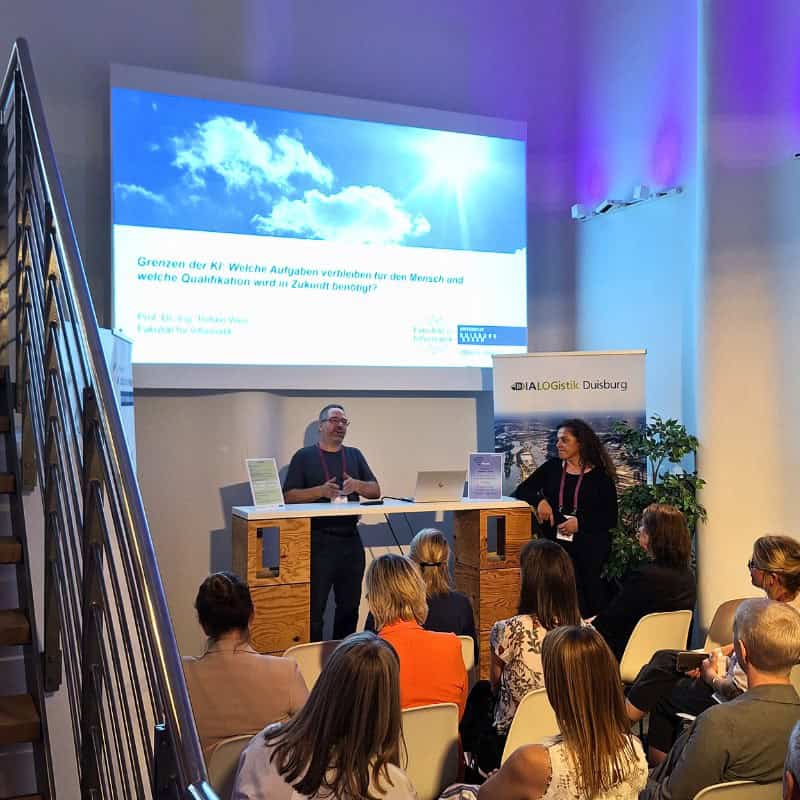
As part of the first DIALOGistik Leadership Festival, which took place at Innenhafen Duisburg at startport, Prof. Dr. Torben Weis, Project Manager of the Center for Applied Artificial Intelligence Duisburg (ZaKI.D) and Dean of the Faculty of Computer Science at the University of Duisburg-Essen, provided fascinating insights into the limits of modern AI systems.
In his scientific keynote “Limits of AI: What Tasks Remain for Humans and What Qualifications Will Be Needed in the Future?” he demonstrated which capabilities machines already master today, where their limits lie, and why human competencies will remain indispensable in the future.
The central insight: Artificial intelligence is fundamentally changing the world of work. Yet, despite all technological advancements, humans remain a decisive factor.
AI Works with Probabilities, Not Truth
A key focus of the keynote was the functioning of modern AI systems. Prof. Dr. Weis explained that AI knows no truths and possesses no insights of its own. Instead, it operates with probabilities and mathematical models.
As he himself put it:
“AI knows no truths. It calculates probabilities and delivers the result with the highest numerical value.”
The answers provided by AI often appear convincing and plausible. However, behind this lies no actual understanding of contexts, but rather the calculation of statistical probabilities. This is precisely why caution is advised: a result can be very likely correct without actually being verifiable or professionally reliable.
The ability to critically question and classify content therefore remains a central human task in the future.
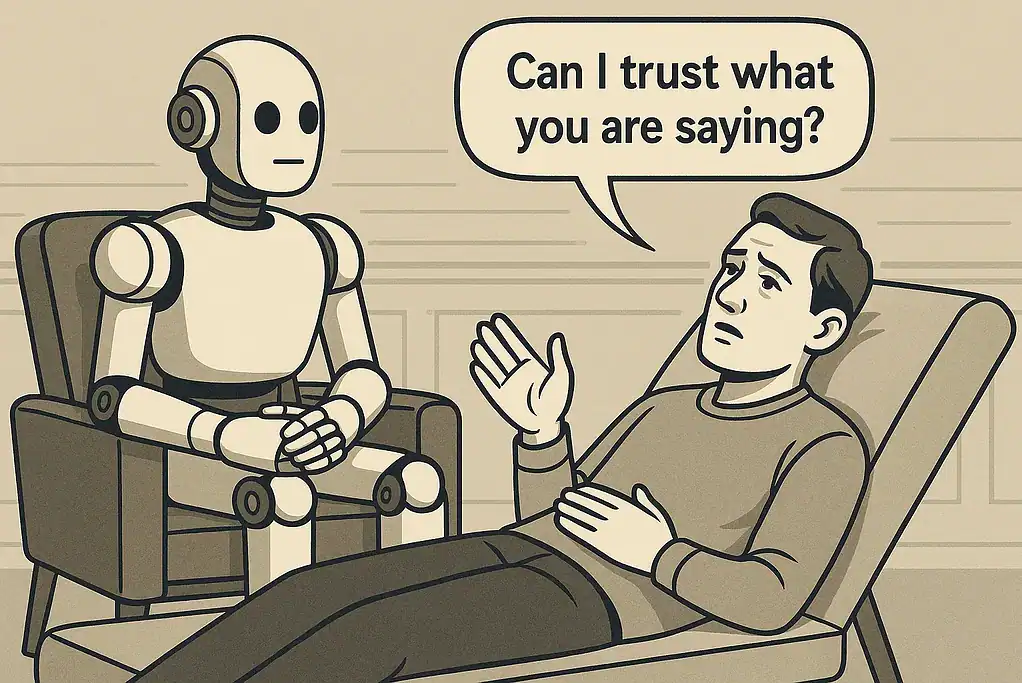
Why We Should Not Blindly Trust AI Results
Another idea from the keynote addressed the role of humans in dealing with AI-generated content. Although AI today creates texts, performs analyses, or supports complex tasks, many people find it increasingly difficult to reliably assess the quality of the results.
The more powerful the systems become, the greater the risk of uncritically adopting answers. The challenge, therefore, is not only to use AI effectively but also to build and maintain sufficient expertise to critically evaluate its results.
The responsibility for evaluating and classifying information ultimately remains with humans.
What Happens When AI Takes Over Entry-Level Roles?
Particularly debatable was the question of AI’s impact on the future world of work. Already today, Artificial Intelligence is taking over numerous tasks that, just a few years ago, were typically performed by entry-level professionals or junior employees.
Prof. Dr. Weis drew attention to a development that could pose new challenges for companies in the coming years:
“If AI takes over junior roles, the question arises: Who will then train the experts of tomorrow?”
Because specialized knowledge is not acquired solely through theory, but primarily through practical experience. If classic entry-level tasks are increasingly automated, the ways in which people build expertise also change. Companies therefore face the task of creating new forms of qualification and competence development.
The discussion clearly showed that the successful integration of AI is not only a technological challenge but, above all, an organizational and societal one.
Productivity Cannot Be Measured in Tokens
Current developments in everyday business were also critically examined. For example, it was discussed that some organizations now evaluate the use of AI tools based on token consumption or similar metrics.
The keynote made it clear that such approaches fall short. The value of work is not measured by how many AI queries are made, but by what results are achieved and what benefits they generate.
Artificial intelligence should therefore be understood as a tool that supports and empowers employees, not as an end in itself or a new performance indicator.
Conclusion
Prof. Dr. Torben Weis’s keynote clearly demonstrated that the discussion about Artificial Intelligence goes far beyond technical questions. AI can accelerate processes, automate tasks, and create new opportunities. At the same time, it raises fundamental questions about responsibility, qualification, and human expertise.
It became particularly clear that the future belongs not to AI alone, but to the interplay of technology and humans. Critical thinking, specialized knowledge, creativity, and the ability to classify complex relationships will remain indispensable even in an increasingly automated world.
The first DIALOGistik Leadership Festival thus offered not only fascinating insights into the possibilities of modern AI systems but also an important impetus for the question of what competencies companies and employees will need in the future to actively shape technological change.